
The New Axenstrasse, the Second Gotthard Road Tunnel, and the remarkable Lake Uri reclamation project
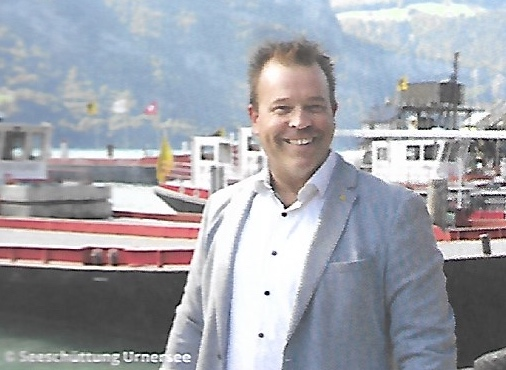
Foreword by Christian Arnold, Government Councilor, Canton Uri
“In the long term, tunnel excavation material will create added value for Lake Uri and therefore for our entire canton.”
Dear residents of Uri,
With the Lake Uri reclamation project, we are undertaking a construction project of extraordinary proportions.
Every day, enormous quantities of material are moved, transportation is coordinated, and numerous activities on and around the lake must be carefully organized.
Successfully managing a construction site of this magnitude requires the highest standards of quality, great care, and a consistent commitment to safety and environmental protection from everyone involved.
A construction project of this size cannot go unnoticed. During the construction period, it inevitably brings changes and certain restrictions.
I would therefore like to sincerely thank the people of Uri, local residents, and everyone who uses Lake Uri for their understanding, consideration, and patience.
Despite all the visible construction activity, we must not lose sight of the project’s ultimate goal: creating ecological benefits.
The excavation material generated during construction of the second Gotthard Road Tunnel and the Sisikon Tunnel will create new habitats for nature.
In this way, material excavated from the mountains will provide long-term benefits for Lake Uri and, ultimately, for our entire canton.
I wish everyone involved a safe and successful construction period and hope you enjoy reading this information about the project.
Christian Arnold
Government Councilor, Canton Uri
New Axenstrasse: Tunnel Construction in Full Swing
Construction of the New Axenstrasse is entering an intensive phase.
In 2026, excavation work began on both the Sisikon and Morschach tunnels. Work is also progressing in the Gumpisch construction area.
The Sisikon Tunnel, approximately 4.4 kilometers long, and the Morschach Tunnel, approximately 2.9 kilometers long, have both been under excavation using drilling and blasting techniques since September 2026.
By 2027, excavation is expected to take place simultaneously at five different locations.
This will mark a particularly intensive stage in construction of the New Axenstrasse.
Large quantities of excavated rock will be generated during tunnel construction. Some of this material will be reused, while another portion will be transported to Lake Uri for the underwater reclamation project.
Construction at Gumpisch
An important part of the construction project is located in Gumpisch.
Work is underway on a protective embankment, using heavy machinery.
This embankment is essential for the continuation of construction work and is designed to protect road users against natural hazards.
Important Milestones in Excavating the Second Gotthard Road Tunnel
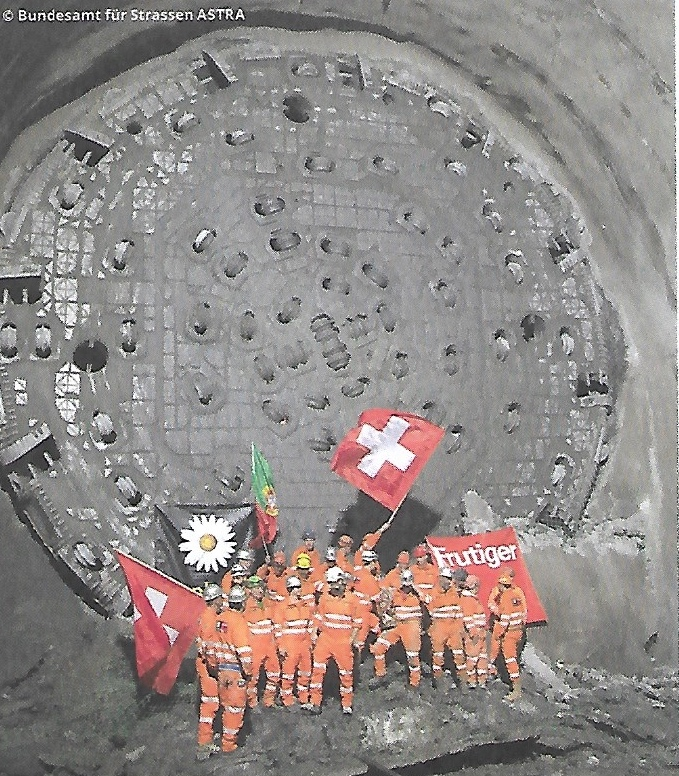
Excavation of the second Gotthard Road Tunnel is progressing steadily.
Important milestones have been reached on both the northern and southern sides of the tunnel during recent months.
Since February 2025, the main excavation work has been taking place from both ends.
On the northern side, the tunnel boring machine (TBM) Alessandra reached the previously excavated geological fault zone known as Mesozikum on April 29, 2026, after advancing approximately four kilometers.
The machine successfully passed through this challenging geological section and was able to resume its normal excavation work.
At the same time, initial finishing work had already begun near the northern tunnel portal.
Significant progress was also made on the southern side.
The tunnel boring machine Paulina had to be stopped at the end of June 2025 because of difficult geological conditions.
It was successfully restarted in May 2026 and has been advancing continuously since then.
Approximately 97 percent of the southern geological fault zone has now been excavated, allowing the tunnel boring machine to pass safely through this particularly demanding section.
These achievements represent important steps towards completion of the second Gotthard Road Tunnel.
Lake Uri Reclamation Reaches Its Most Intensive Phase
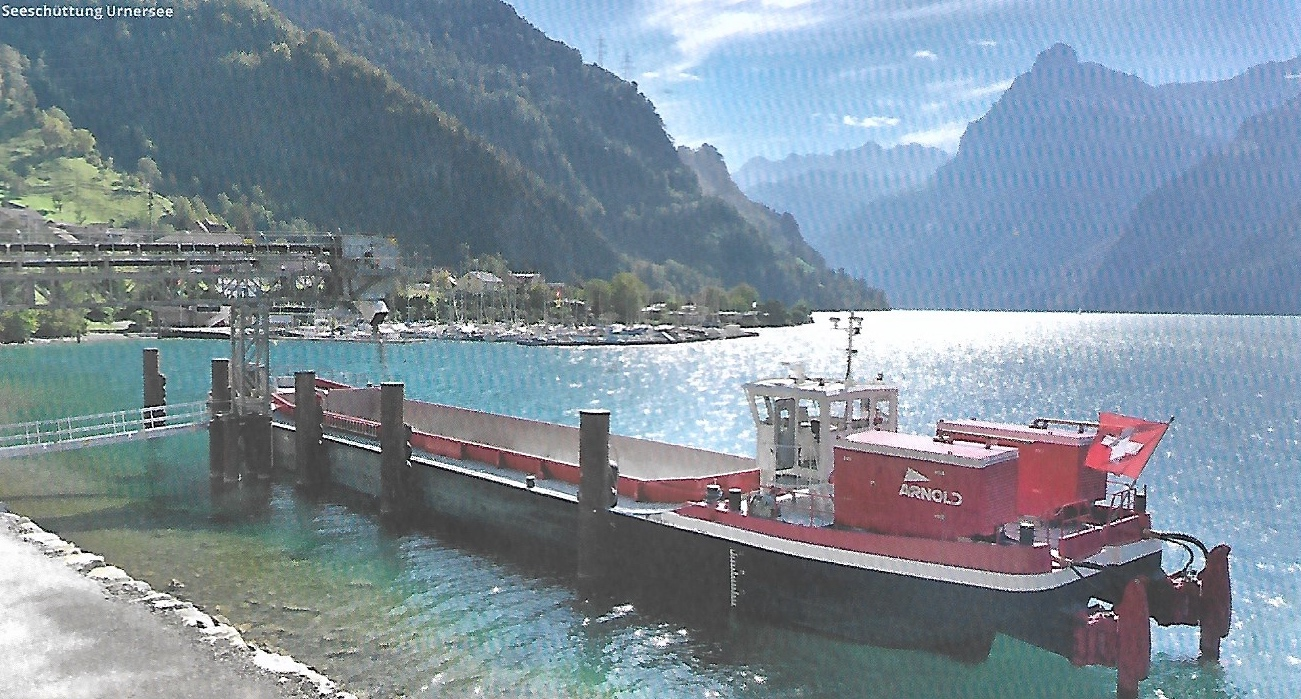
Since the beginning of October 2026, all three loading stations supplying the Lake Uri reclamation project have been operating simultaneously for the first time.
This marks a major milestone in the project’s material transportation system.
Every day, approximately 12,000 tonnes of excavated rock are transported to the designated dumping sites in Lake Uri.
The opening of the Dorni loading station at the beginning of October 2026 completed the transport infrastructure.
For the first time, excavated material from both the second Gotthard Road Tunnel and the new Sisikon Tunnel can be transported simultaneously through all three loading stations.
According to Roland Senn, project manager of the Lake Uri reclamation project, this allows the full parallel operation of material deliveries from both tunnel construction sites.
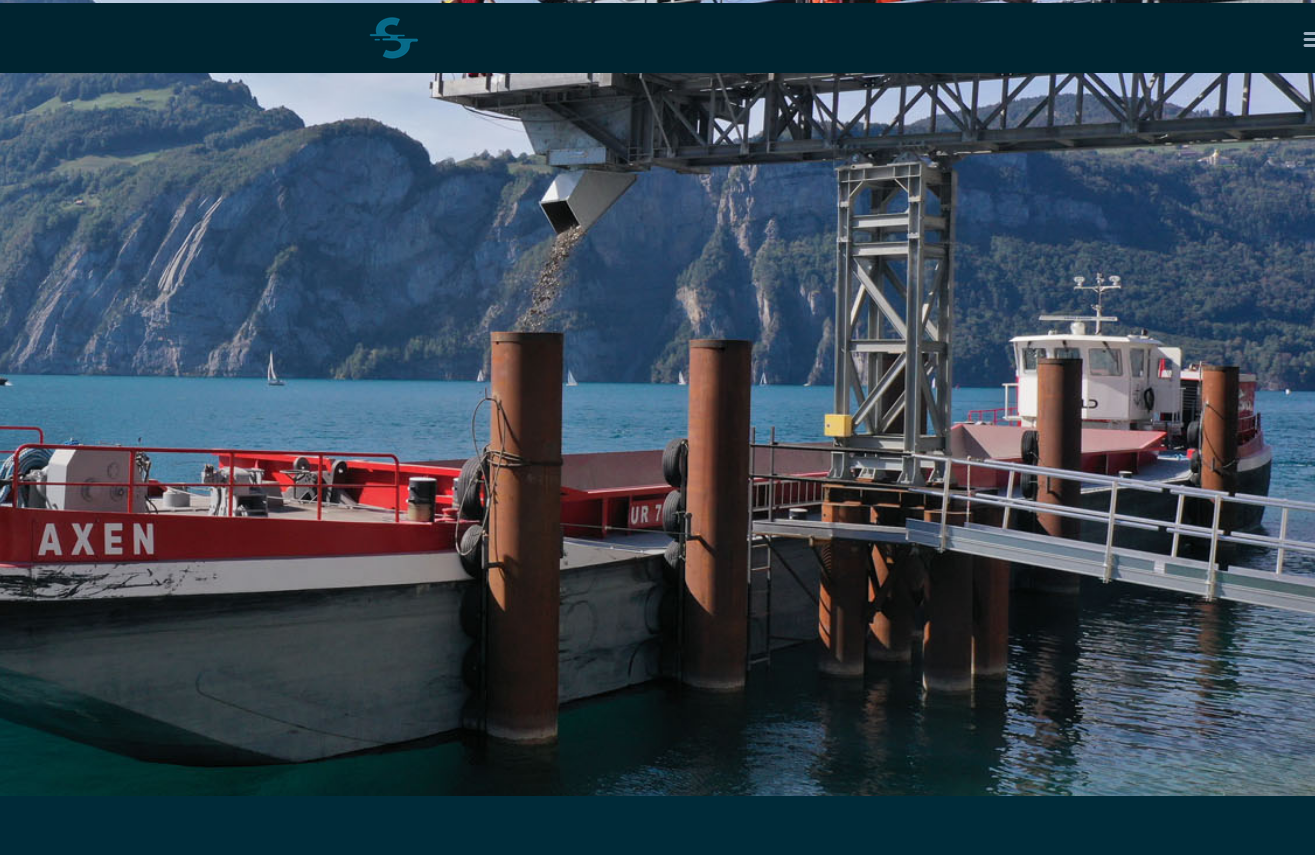
Three Routes Lead to the Lake
Excavated material from the Gotthard tunnel is transported by freight train to the industrial harbour in Flüelen.
There, the rock is loaded onto special bottom-dumping barges.
Material from the Axenstrasse project reaches the lake by two different routes.
Rock excavated from the Gumpisch exit tunnel and the southern section of the new Sisikon Tunnel is transported by truck to Rudenz harbour in Flüelen, where it is loaded onto barges.
The new Dorni loading station provides a third route.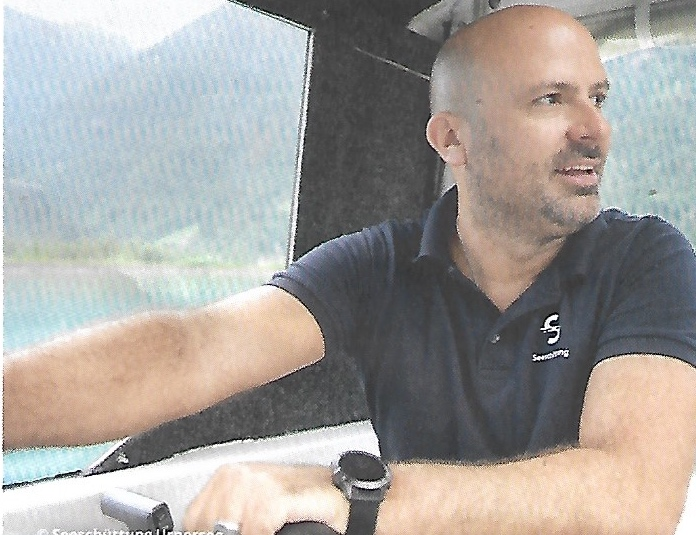
Material from the northern section of the Sisikon Tunnel is transported directly from the tunnel to the loading station by conveyor belt.
From there, it is loaded onto barges for transportation to the underwater dumping sites.
Conditions at the Two Reclamation Sites
As the quantity of excavated material increases, activity at the two reclamation sites, Allmeini and Schanz, also intensifies.
At Allmeini, primarily Palfris marl from the new Sisikon Tunnel is being deposited.
This material fills the previously prepared underwater basin.
A final covering layer approximately 50 centimetres thick is expected to be installed in spring 2027.
Once this layer is completed, reclamation work at this location can be concluded.
At Schanz, several activities are taking place simultaneously.
In addition to depositing Palfris marl, preparations are underway to accommodate partially arsenic-bearing Betlis limestone from the new Sisikon Tunnel.
Approximately 500 tonnes of this material, equivalent to about one barge load, will eventually be deposited each day in the designated area.
This increases the need for careful coordination on the lake, as material is sometimes deposited at three locations simultaneously.
Further Strengthening Ecological Diversity
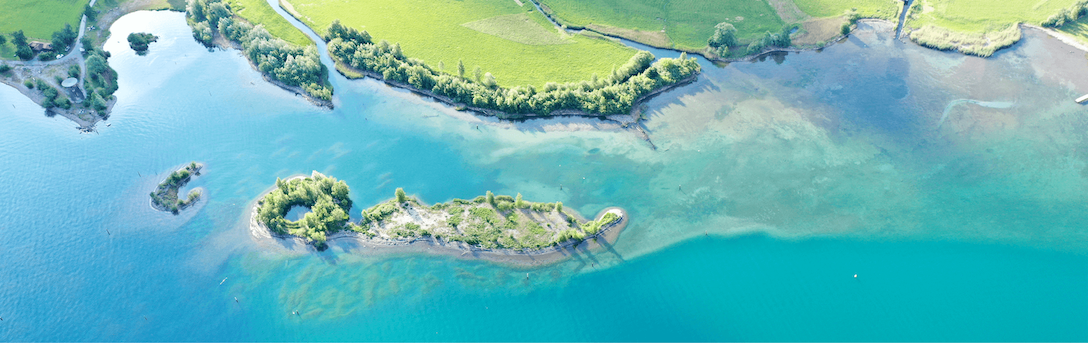
Approximately 1.9 million tonnes of excavated material have already been deposited in Lake Uri.
The new underwater landscape is gradually taking shape.
By the time the project is completed, seven hectares of new shallow-water zones will have been created.
These areas will provide valuable habitats for fish, small aquatic organisms, and water plants.
They will also enhance the ecological environment along the southern shore of Lake Uri.
According to the current construction schedule, reclamation work is expected to be completed by summer 2030.
Removing Detonator Tubes from Lake Uri
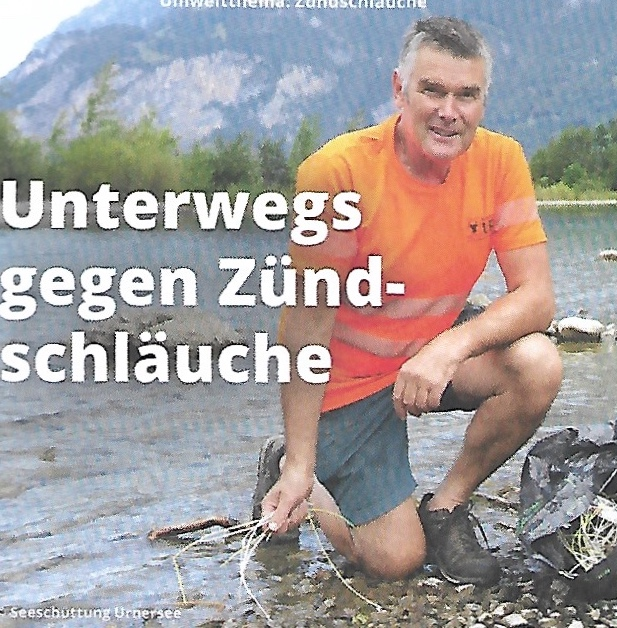
As long as material from tunnel blasting operations continues to be deposited in Lake Uri, plastic detonator tubes will occasionally wash ashore.
A dedicated cleaning team regularly removes these materials to keep the shoreline clean.
Detonator tubes are used during blasting operations inside the tunnels.
Despite extensive processing and sorting, they cannot always be completely removed from the excavated rock.
Because the tubes are lighter than water, they may float to the surface after the material has been deposited.
Wind and waves can then carry them towards the shoreline.
Although the tubes do not affect water quality, they are unwanted plastic waste.
Cleaning Operations Two or Three Times a Week
A cleaning team inspects the Reuss Delta, bathing islands, protective embankments, and shoreline areas between Isleten and Gruonbach two or three times each week.
Any detonator tubes or other plastic debris that have washed ashore are collected and properly disposed of.
Cleaning operations on the protected nature islands are coordinated by the Reuss Delta Commission.
Beat Infanger, a member of the cleaning team, particularly appreciates the assistance of local residents.
He regularly finds detonator tubes collected by members of the public and placed in designated waste containers.
“It is wonderful to see the population helping out and everyone working towards the same goal,” he explains.
Regular inspections will continue as long as excavated material from blasting operations is deposited in the lake.
This means the cleaning team is expected to remain active until the project is completed in 2030.
Naturally Occurring Arsenic: Protective Measures in Place
Beginning in 2027, excavated material from the Sisikon Tunnel containing naturally occurring arsenic will also be deposited in Lake Uri.
Comprehensive protective and monitoring measures are intended to ensure that this material can be deposited in an environmentally responsible manner.
The material consists partly of Betlis limestone, which naturally contains what is known as geogenic arsenic.
Extensive preliminary investigations have shown that the limestone can be deposited in Lake Uri provided the established protective measures are followed.
According to Lorenz Jaun, head of the Canton Uri Office for the Environment, the arsenic is bound within the limestone and is therefore released into the lake water only in small quantities.
Depositing, Covering, and Monitoring
The arsenic-bearing limestone will be deposited within the pontoon installation, at a considerable distance from the shoreline.
It will then be covered with material that is not contaminated with geogenic arsenic.
Regular analyses of both the deposited material and lake water will be carried out.
The Office for the Environment will review the results and monitor the implementation of all protective measures.
These inspections are intended to ensure that environmental requirements are met throughout the reclamation project.
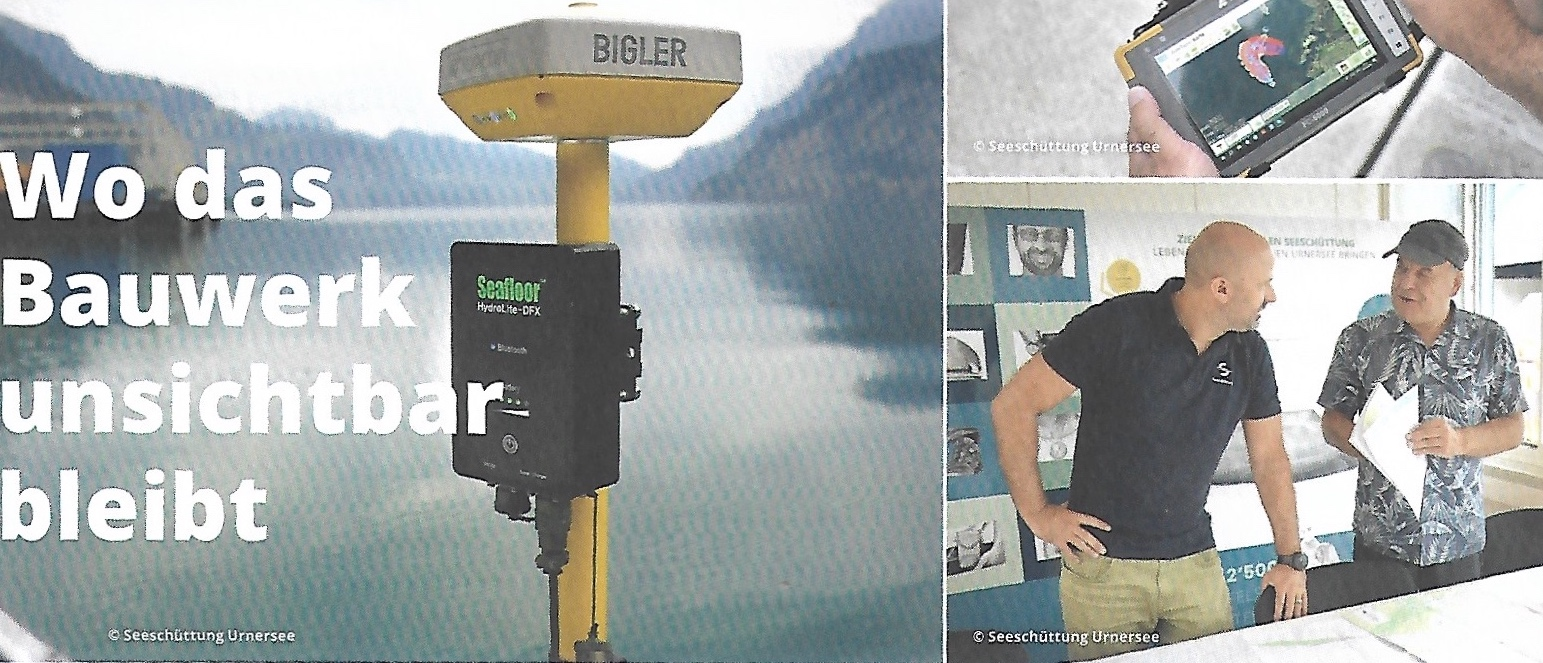
Where the Construction Work Remains Invisible
Beneath the surface of Lake Uri, a new underwater landscape is being created, layer by layer.
Ensuring that the deposited material ends up exactly where it belongs is the responsibility of Daniel Gisler.
As construction manager for Bigler AG, he coordinates, supervises, and measures the work taking place on the lake.
On this particular morning, Lake Uri is calm.
Conditions are ideal for Daniel Gisler, who takes his boat over the Schanz reclamation site and uses sonar equipment to measure the lake-bed.
What lies several meters below the surface cannot be seen with the naked eye.
Only the measurement data reveals the shape the underwater deposits have taken and where additional material needs to be placed.
“On a construction site on land, you can see the structure growing. Underwater, you see nothing. Without sonar, we would be blind,” he explains.
Depositing Material According to Plan
As construction manager for the Lake Uri reclamation project, Daniel Gisler is responsible for ensuring that the two underwater deposits at Schanz and Allmeini are constructed according to the plans and calculations prepared by Bigler AG.
His responsibilities also include compliance with operating hours, legal regulations, safety requirements, and accurate accounting of the work performed.
His working day usually begins not on the lake, but in the office.
There, he first examines the latest information supplied by the reclamation contractor.
How far has the work progressed? What water depth has been reached? How much material has already been deposited? Does the pontoon need to be re-positioned?
He then coordinates with the contractor to determine where work will take place that day and how many barge loads are expected.
At the same time, he must know how much material will be available over the coming days and weeks.
The quantities supplied from the Gotthard Road Tunnel and the Sisikon Tunnel are constantly monitored.
“I prepare the reclamation schedule, so I have to keep all the threads in my hands,” he explains.
Measuring, Monitoring, and Planning Ahead
After the pontoon has been moved two or three times, the lake-bed is surveyed again.
The measurements show whether the material has settled as expected.
Even with careful planning, it is impossible to predict exactly what will happen underwater.
Fine material may be washed away, while currents and waves influence the deposits.
The pontoon itself can also move slightly despite being secured with ropes or chains.
Based on the survey results, the next dumping positions are determined in stages of approximately ten meters.
Sometimes areas that have already been filled must be corrected.
“On land, you leave footprints behind. On the lake, we rely on GPS and measurement data.”
A Construction Site Constantly in Motion
With all three loading stations now operating, the Lake Uri reclamation project has reached its most intensive phase.
Since October, considerably larger quantities of material have been arriving at the lake, sometimes being deposited simultaneously at several locations.
For Daniel Gisler, this means more material, increased boat traffic, and shorter intervals between individual operations.
A Construction Site in Motion
Weather conditions also have a considerable influence on work on the lake.
Accurate surveying of the lake-bed requires the calmest possible water.
When strong winds develop, measurements become almost impossible.
Even under favourable conditions, approaching a specific point on the water with absolute precision is more difficult than it might appear from the shore.
“Driving a boat looks easy, but there is more to it than people think,” says Gisler with a smile.
These particular challenges are what make the Lake Uri reclamation project such an unusual construction site.
Daniel Gisler particularly enjoys the early mornings and evenings on the lake.
There is little traffic, the water is calm, and the atmosphere is unlike that of a conventional construction site.
Sometimes, nature itself provides unexpected moments.
During a recent surveying trip, Gisler discovered a large fish swimming beside his boat.
It was a small but memorable experience in the middle of a busy construction project.
“It is important to me that, in the end, something good is created here for the underwater world.”
Until 2030, Daniel Gisler will continue supervising the development of the two underwater reclamation areas.
He gladly accepts this unusual assignment.
“A project of this magnitude is unique in a professional career.”
Competition – Win an Exclusive Visit to the Reclamation Site
The Lake Uri reclamation project is organizing a competition.
The question is:
How many meters of yellow and orange floating debris barriers have been installed in total for the Lake Uri reclamation project?
Participants can email their estimate, together with their contact information, to:
kommunikation@seeschuettung.ch
Closing date: December 15, 2026.
The winner will be contacted directly and will receive an exclusive visit to a reclamation operation.
Discover the Lake Uri Reclamation Project as a Group
Beginning in January 2027, a new visitor program will be available for groups interested in learning more about the project.
Groups of six to fifteen people can book guided tours offering a behind-the-scenes look at this major construction undertaking.
The program can be tailored to individual interests.
Options include visiting the information pavilion, attending a detailed presentation, or touring the construction area.
Guided visits are available for a contribution towards costs and can be booked directly through the Lake Uri reclamation project website.
Information and booking opportunities will be available online beginning in December 2026.
Website: https://www.seeschuettung.ch/besucher
Final Thoughts – An Extraordinary Project for Central Switzerland
The construction of the second Gotthard Road Tunnel and the New Axenstrasse represents one of the most ambitious infrastructure developments currently taking place in Central Switzerland.
But perhaps one of the most fascinating aspects is what happens to the millions of tonnes of rock excavated from deep inside the mountains.
Rather than simply disposing of this material, a substantial portion is being used to create an entirely new underwater landscape in Lake Uri.
The coordination involved is remarkable.
Freight trains, trucks, conveyor belts, specialized barges, construction crews, engineers, and environmental specialists all work together to move thousands of tonnes of material every day.
At the same time, the environmental challenges should not be overlooked.
Naturally occurring arsenic, plastic residues from blasting operations, and the long-term effects of underwater deposition require careful monitoring and responsible management.
If the project achieves its intended ecological objectives, it will demonstrate how major infrastructure construction can also contribute to restoring natural habitats.
By 2030, seven hectares of new shallow-water areas are expected to provide valuable habitat for fish, aquatic plants, and other wildlife.
What began as rock excavated from the Gotthard and Axenstrasse tunnels may ultimately become a lasting ecological asset for Lake Uri and future generations.
Source: Seeschüttung Urnersee – Project Information, 2026. Translated and edited into English for blog publication by Ulrich Köpf
For further information: www.seeschuettung.ch


Leave a Reply